
Follow us on social:
The Details of your Plumbing Systems
Go through each main system of your house's plumbing to ensure you understand how something works and what you need to do to keep it working well.

Basic Anatomy of a Toilet
Most toilet problems come down to a handful of cheap parts in the tank. Once you know what is in there, you can diagnose most issues yourself, and know exactly when it's time to call a plumber.
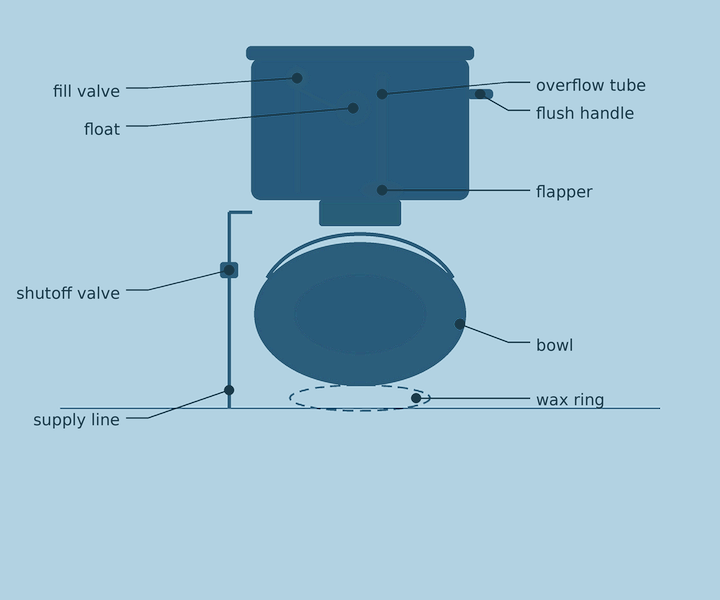
Common Toilet Problems
Common toilet problems often manifest as minor nuisances that can lead to significant infrastructure damage. Identifying issues like 'ghost flushing,' phantom running, or persistent clogs early is essential for maintaining household efficiency and preventing water waste.
The toilet flushes on its own periodically, usually due to a slow leak from the tank into the bowl caused by a failing flapper.
Ghost Flushing
Running Toilet
Water continues to trickle into the overflow tube or bowl after the tank is full, often wasting hundreds of gallons per month.
Repeated blockages in the trap or main line can indicate a vent pipe obstruction or a deeper systemic plumbing failure.
Persistent Clogs
Weak Flush
Usually one of two causes: mineral buildup clogging the rim jets (the small holes under the bowl rim), or a flapper that closes too quickly and cuts the flush short.
Leaking Base
Water pooling on the floor or at the base of the toilet typically indicates the wax ring seal has failed. This can lead to structural tile damage, hidden mold or rot if not addressed early.
Some Toilet Issues Need a Professional
DIY goes a long way with toilets, but these situations call for a professional
1
Wax Ring Replacement: requires removing the toilet, setting a new wax ring, and re-setting the toilet precisely. One wrong move and you're back where you started.
2
Damaged floor flange: if the flange (the fitting in the floor) is cracked, broken, or sits too low, a plumber needs to repair or raise it before a new wax ring will hold.
3
Persistent clogs: if a plunger and drain snake don't clear a clog, you may have a deeper blockage in the drain line. A plumber with an auger or camera is likely needed.
4
Slow drain throughout home: if multiple toilets or sinks drain slowly at once, it is likely a main drain or venting issue, not a single-toilet problem. It needs a professional assessment.
Faucets and Fixtures: Knowing How to Stop the Drips

A dripping faucet is easy to live with until you see the water bill. Most faucet problems come down to a cartridge, o-ring, or aerator. Knowing the difference saves you a service call and a surprise in your bill.
Faucet maintenance is among the easiest plumbing work a homeowner can do. Cleaning an aerator takes five minutes. replacing a cartridge takes thirty. Neither requires a plumber, unless you ignore the problem.
Common Problems of Faucets and Fixtures
Common issues with faucets and fixtures often manifest as slow drips, mineral buildup on aerators, or handle stiffness. This guide outlines diagnostic steps to determine if a simple rubber seal replacement is necessary or if the internal cartridge has reached its service limit. Stay-frame assists in maintaining fixture integrity and water efficiency through clear technical pathways.
Slow Drips
A persistent drip usually signals a worn O-ring or a mineral-clogged valve seat that prevents a proper seal.
Leaking Base
Water pooling around the base of the faucet often indicates faulty seals between the spout and the fixture body.
Handle Stiffness
Hard water deposits can accumulate inside the handle mechanism, making it difficult or impossible to operate smoothly.
Whistling Sound
Internal components vibrating against water flow can create a high-pitched noise, signaling loose internal parts.
Mineral Buildup
White crusty deposits on the aerator can restrict water flow and cause irregular spray patterns throughout the sink.
Low Pressure
Sudden pressure loss often stems from debris trapped in the faucet cartridge or the aerator screen.
Faucets and Fixtures: When to call a Professional
While many minor faucet issues can be addressed with basic tools, certain scenarios demand the expertise of a licensed master plumber. Professional intervention ensures technical integrity and code compliance.
1
Internal Valve Integration: Requires removing complex cartridges inside the wall without damaging the supply lines or surrounding tile work.
2
Supply Line Failure: If a supply line fails beneath the cabinet or inside the wall, a plumber must ensure code-compliant, water-tight repairs. You may need to shut off the main water supply until it is repaired
3
Aging Infrastructure Upgrades: Older properties requiring full fixture swaps often involve galvanized pipe conversions that require technical expertise to execute safely.
4
Whole House Pressure Loss: If multiple faucets suddenly have low pressure at once, a failing pressure regulator or main supply line issue may be the cause, and that needs professional diagnosis.
Water Filtration and Why it is Important
Water filtration systems are fundamental to modern home plumbing architecture, engineered to neutralize impurities and preserve the long-term integrity of your fixtures and piping. From high-capacity whole-house sediment filters to precision point-of-use reverse osmosis units, these systems create a robust barrier against minerals, particulates, and chemical additives that can affect water taste and infrastructure health.
An overdue filter isn't just ineffective, it can actually become a source of contamination.
Whole-house, under-sink, and fridge filters all have different service schedules. It's important to know the differences.
Common Problems of Water Filtration Systems
Common malfunctions in filtration systems often manifest as significant pressure drops or changes in water clarity. Key issues to monitor include clogged sediment pre-filters, bypass valve failures, and exhausted media beds. Regular diagnostic checks prevent bypass leaks and ensure reverse osmosis units continue to eliminate contaminants effectively.
Clogged Pre-filters
Sediment buildup in pre-filtration stages restricts flow and increases pressure across the housing.
Bypass Failures
Valves stuck in the bypass position allow untreated water to enter service lines directly.
Exhausted Media
Saturation prevents media from effectively neutralizing minerals and chemical particulates.
Significant pressure drops often indicate blockages in high-density sediment filter beds.
Pressure Loss
Membrane Fouling
Reverse osmosis units can stall as membranes become coated with organic bio-matter.
Seal Degradation
O-rings and internal seals in the bypass assembly can degrade over time, leading to hidden leaks.